


-
Regular price $1,449.00Sale price $1,449.00 Regular price
$2,898.00 -
Regular price $1,449.00Sale price $1,449.00 Regular price
$2,898.00 -
Limited EditionRegular price $1,790.00Sale price $1,790.00 Regular price
$3,580.00 -
Regular price $1,710.00Sale price $1,710.00 Regular price
$3,420.00 -
Regular price $1,410.00Sale price $1,410.00 Regular price
$2,820.00 -
Regular price $1,770.00Sale price $1,770.00 Regular price
$3,540.00 -
Regular price $2,000.00Sale price $2,000.00 Regular price
$4,000.00 -
Regular price $2,050.00Sale price $2,050.00 Regular price
$4,100.00 -
Regular price $2,430.00Sale price $2,430.00 Regular price
$4,860.00 -
Regular price $1,460.00Sale price $1,460.00 Regular price
$2,920.00 -
Regular price $1,360.00Sale price $1,360.00 Regular price
$2,720.00 -
Regular price $1,440.00Sale price $1,440.00 Regular price
$2,880.00 -
Regular price $2,040.00Sale price $2,040.00 Regular price
$4,080.00 -
Regular price $1,510.00Sale price $1,510.00 Regular price
$3,020.00 -
Regular price $1,210.00Sale price $1,210.00 Regular price
$2,420.00 -
Regular price $1,560.00Sale price $1,560.00 Regular price
$3,120.00 -
Regular price $1,290.00Sale price $1,290.00 Regular price
$2,580.00 -
Regular price $1,310.00Sale price $1,310.00 Regular price
$2,620.00 -
Regular price $1,520.00Sale price $1,520.00 Regular price
$3,040.00 -
Limited EditionRegular price $2,580.00Sale price $2,580.00 Regular price
$5,160.00 -
Limited EditionRegular price $1,780.00Sale price $1,780.00 Regular price
$3,560.00 -
Limited EditionRegular price $1,850.00Sale price $1,850.00 Regular price
$3,700.00 -
Limited EditionRegular price $1,910.00Sale price $1,910.00 Regular price
$3,820.00 -
Limited EditionRegular price $1,990.00Sale price $1,990.00 Regular price
$3,980.00 -
Limited EditionRegular price $2,460.00Sale price $2,460.00 Regular price
$4,920.00 -
Regular price $1,550.00Sale price $1,550.00 Regular price
$3,100.00 -
Regular price $1,140.00Sale price $1,140.00 Regular price
$2,280.00 -
Regular price $1,600.00Sale price $1,600.00 Regular price
$3,200.00 -
Regular price $2,150.00Sale price $2,150.00 Regular price
$4,300.00 -
Regular price $1,520.00Sale price $1,520.00 Regular price
$3,040.00 -
Regular price $1,050.00Sale price $1,050.00 Regular price
$2,100.00 -
Regular price $1,590.00Sale price $1,590.00 Regular price
$3,180.00 -
Regular price $3,380.00Sale price $3,380.00 Regular price
$6,760.00 -
Regular price $1,370.00Sale price $1,370.00 Regular price
$2,740.00 -
Regular price $1,540.00Sale price $1,540.00 Regular price
$3,080.00 -
Regular price $1,520.00Sale price $1,520.00 Regular price
$3,040.00




Showing 24 of 36
Buying Guide
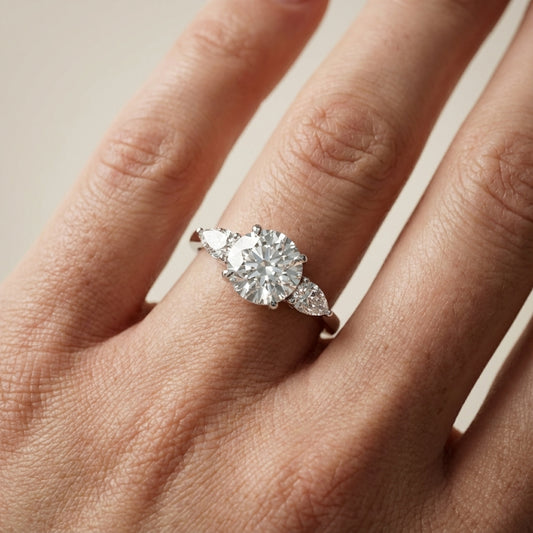
There is a short answer to why people choose round cut designs. The girdle on a round should be faintly visible, not knife-thin and not bulky. Platinum work is done at higher temperatures, which is why fewer workshops set difficult stones in it.
The report number is laser-inscribed on the girdle, so the paperwork can always be matched to the stone. The report number is inscribed on the girdle, so stone and paperwork can always be matched. Every stone is IGI-certified in D–F colour, VVS–VS clarity and Excellent cut, and every piece is made to order with free U.S. shipping and 65-day returns. Browse Round Cut Lab Grown Diamond Engagement Rings instead if you have not fixed on this combination.
Frequently Asked Questions
Why is a round brilliant the most expensive shape per carat?
Because it wastes the most rough. Cutting a round brilliant typically discards more than half the original crystal to reach the 57-facet proportions that produce its light return. Every other shape uses the rough more efficiently, which is why the same budget buys more visible carat weight in an oval or an emerald cut.
Which shapes hide inclusions best?
Brilliant cuts hide them best. Round, oval, pear, cushion and radiant scatter light across dozens of facets, which masks small inclusions. Step cuts — emerald and asscher — have long open facets that act like windows into the stone. That is exactly why our VVS–VS clarity floor matters most on step cuts, where there is nowhere for an inclusion to hide.
Why is platinum more expensive than gold?
Density, mostly. Platinum is significantly heavier than gold, so the same ring takes noticeably more metal, and it is worked at higher temperatures. You are also buying a metal that needs no plating for the life of the piece. We carry 458 platinum designs across every shape we cut.
Does the metal change how the diamond looks?
At the margins, yes. A white metal keeps a colourless stone reading colourless. Yellow and rose gold reflect a little warmth into the stone, which can make a lower color grade look warmer than it is. Because we hold a D–F color floor across the range, our stones perform well in all four metals.
Will lab grown diamonds be worthless in the future?
Worthless is the wrong word for the object and closer to the right word for the trade. The stone keeps the crystal structure of any diamond, stays a 10 on the Mohs scale, and its optical properties will never fade or cloud, so it looks in fifty years the way it looks today. What can keep falling is what a stranger will pay you for a used one.
- IGI certification Every Beyond Carat diamond is graded by IGI, and the report ships in the box.
- Flexible payments Affirm monthly payments and Shop Pay Installments at checkout.
- Returns 65-day returns, measured from the date your order ships. Free prepaid, insured UPS return label on U.S. orders. Free ring resizing for a full year.
- Warranty Lifetime manufacturing warranty covering defects in materials and workmanship.
Not sure where to start? Book a free 30-minute call with our team — video or phone, no obligation.