


-
Prix habituel $1,149.00Prix promotionnel $1,149.00 Prix habituel
$2,298.00 -
Prix habituel $1,049.00Prix promotionnel $1,049.00 Prix habituel
$2,098.00 -
Prix habituel $1,170.00Prix promotionnel $1,170.00 Prix habituel
$2,340.00 -
Prix habituel $1,049.00Prix promotionnel $1,049.00 Prix habituel
$2,098.00 -
Prix habituel $1,310.00Prix promotionnel $1,310.00 Prix habituel
$2,620.00 -
Prix habituel $1,130.00Prix promotionnel $1,130.00 Prix habituel
$2,260.00 -
Prix habituel $1,150.00Prix promotionnel $1,150.00 Prix habituel
$2,300.00 -
Prix habituel $1,480.00Prix promotionnel $1,480.00 Prix habituel
$2,960.00



Showing 8 of 465
Buying Guide
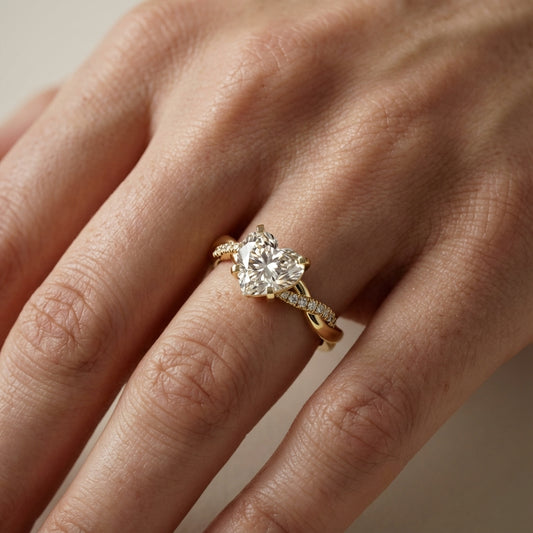
Heart is the hardest outline we cut well, and symmetry matters more here than on any other shape. The two lobes have to match, the cleft has to sit centrally, and the point at the base has to align with it — get any of those slightly wrong and the stone reads as an error rather than as a heart from arm’s length. That is what the Excellent cut grade is protecting on this page.
Size is the other constraint. Below about half a carat the cleft stops reading and the stone can look like a round from any distance, which defeats the point of choosing it, so we would go larger on a heart than on a round. Brilliant faceting underneath hides inclusions well, so the clarity grade is less visible here than the symmetry is. Both the cleft and the point are vulnerable, which makes setting choice matter more than metal choice. Made to order with free worldwide shipping and 65-day returns.
Frequently Asked Questions
What makes a heart shaped diamond difficult to cut well?
The cleft. A heart is a modified brilliant with a notch at the top, and the two lobes have to mirror each other precisely or the shape reads lopsided from arm’s length. Symmetry matters more here than on any other shape. We carry 82 heart pieces across the range, all IGI-certified and cut to an Excellent standard.
Is there a minimum size for a heart shaped diamond?
In practice, yes. Below about half a carat the cleft becomes hard to read and the stone can look like a round from a distance, which defeats the point. If you want the shape to be recognisable, we recommend going larger on a heart than you would on a round.
Which lab grown diamond shape is most popular right now?
Round is still the most requested — 837 of our pieces across the range are round — followed by princess at 204 and emerald at 169. Oval has grown fastest over the last few seasons and now sits at 165 pieces. We would not choose on popularity alone; shape is the one decision on a ring that is purely about taste.
Which diamond shape suits a smaller finger?
Elongated shapes flatter a narrow finger. Oval, marquise and pear draw the eye lengthwise and make the finger read longer. A wide shape at high carat can overwhelm a slim band, so if you are set on a cushion or a round we recommend keeping the band proportionate rather than dropping carat weight.
Which setting protects the diamond best?
A bezel, which wraps metal around the girdle of the stone, protects best. Among prong settings, six prongs hold more securely than four, and a lower profile keeps the stone out of the way of impact. We set pear and marquise points under a V-prong as standard for the same reason.
- IGI certification Every Beyond Carat diamond is graded by IGI, and the report ships in the box.
- Flexible payments Affirm monthly payments and Shop Pay Installments at checkout.
- Returns 65-day returns, measured from the date your order ships. Free prepaid, insured UPS return label on U.S. orders. Free ring resizing for a full year.
- Warranty Lifetime manufacturing warranty covering defects in materials and workmanship.
Not sure where to start? Book a free 30-minute call with our team — video or phone, no obligation.