


-
Prix habituel $1,249.00Prix promotionnel $1,249.00 Prix habituel
$2,498.00 -
Prix habituel $1,049.00Prix promotionnel $1,049.00 Prix habituel
$2,098.00 -
Prix habituel $1,149.00Prix promotionnel $1,149.00 Prix habituel
$2,298.00 -
Prix habituel $1,249.00Prix promotionnel $1,249.00 Prix habituel
$2,498.00 -
Prix habituel $1,049.00Prix promotionnel $1,049.00 Prix habituel
$2,098.00 -
Prix habituel $1,049.00Prix promotionnel $1,049.00 Prix habituel
$2,098.00 -
Prix habituel $1,310.00Prix promotionnel $1,310.00 Prix habituel
$2,620.00 -
Prix habituel $1,049.00Prix promotionnel $1,049.00 Prix habituel
$2,098.00 -
Prix habituel $1,290.00Prix promotionnel $1,290.00 Prix habituel
$2,580.00 -
Prix habituel $1,280.00Prix promotionnel $1,280.00 Prix habituel
$2,560.00






Showing 10 of 4804
Buying Guide
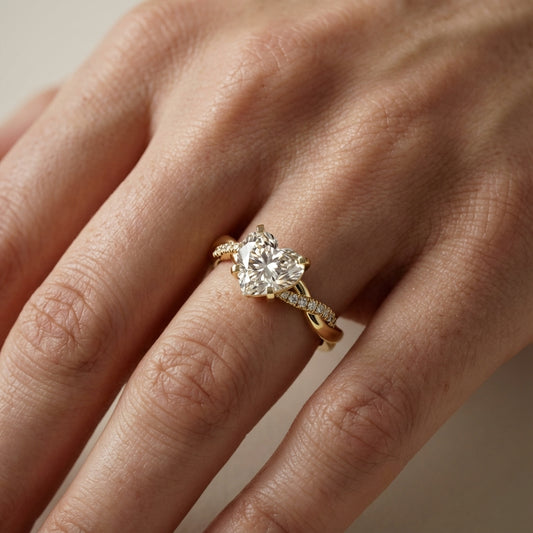
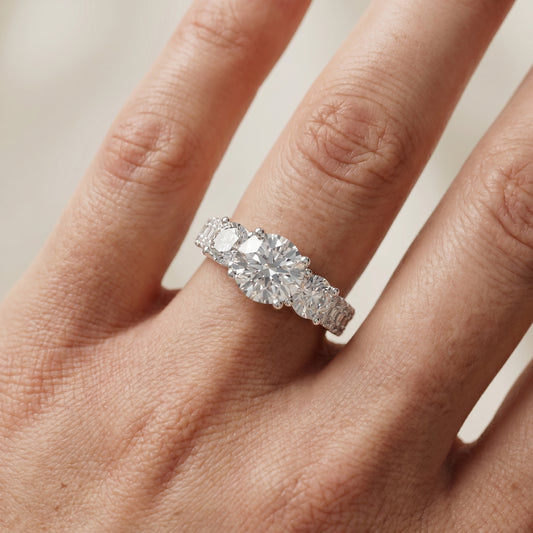
This is the widest view of our ring range, and the three decisions inside it are shape, setting and metal — in that order of visible impact. Shape is where apparent size and price per carat are decided together, and the two pull against each other: the roundest outlines are the most expensive to cut and the least generous on the finger, while the longest ones are the cheapest and the most generous.
Setting decides how much of the budget reaches the centre stone. A solitaire puts all of it there; three stone and side stone buy carat weight more cheaply by moving it off-centre; a halo buys roughly half a carat of extra visual presence for a fraction of what the same step would cost in the centre stone. Metal is the last decision and the least reversible, because platinum needs no plating and white gold does. Every stone is IGI-certified in D–F colour, VVS–VS clarity and Excellent cut, and every piece is made to order with free worldwide shipping and 65-day returns.
Frequently Asked Questions
How much does a lab grown diamond engagement ring cost?
A complete one-carat lab-grown diamond solitaire starts around $1,049 at Beyond Carat, with the stone set and certified. From there the price moves with carat weight, color, clarity, metal and setting complexity. Our full range runs from $269 for stud earrings to several thousand for larger centre stones in platinum.
Who certifies your diamonds?
IGI, the International Gemological Institute. Every Beyond Carat diamond is graded by IGI and the report ships in the box with the piece, with the report number laser-inscribed on the girdle of the stone so it can be matched back to the paperwork at any time.
What is a solitaire and why is it the most common setting?
A solitaire is a single centre stone on a plain band. It is the most common setting because it does three things at once: it gives the diamond the most light, it pairs flush with almost any wedding band, and it puts the entire budget into one stone rather than splitting it. We carry 570 solitaire designs across the range designs.
Which lab grown diamond shape looks largest for the carat?
Elongated shapes look largest. Oval, marquise and pear spread their weight along the finger rather than down into the stone, so a 1-carat oval reads close to a 1.2-carat round. Round and asscher carry more weight in depth and read smallest per carat. If visual size is the priority, we recommend starting with oval or marquise.
Is Beyond Carat a legitimate company?
Yes, and every part of that is checkable rather than asserted. We are rated 4.8 out of 5 on Trustpilot across 43 reviews as of August 2026, we work from 62 W 47th St #14A-10 in the New York Diamond District, and our number, (888) 625-7772, is answered Monday to Saturday. Every diamond is IGI-certified with the report in the box and its number laser-inscribed on the girdle, and returns run 65 days from the date your order ships.
- IGI certification Every Beyond Carat diamond is graded by IGI, and the report ships in the box.
- Flexible payments Affirm monthly payments and Shop Pay Installments at checkout.
- Returns 65-day returns, measured from the date your order ships. Free prepaid, insured UPS return label on U.S. orders. Free ring resizing for a full year.
- Warranty Lifetime manufacturing warranty covering defects in materials and workmanship.
Not sure where to start? Book a free 30-minute call with our team — video or phone, no obligation.